

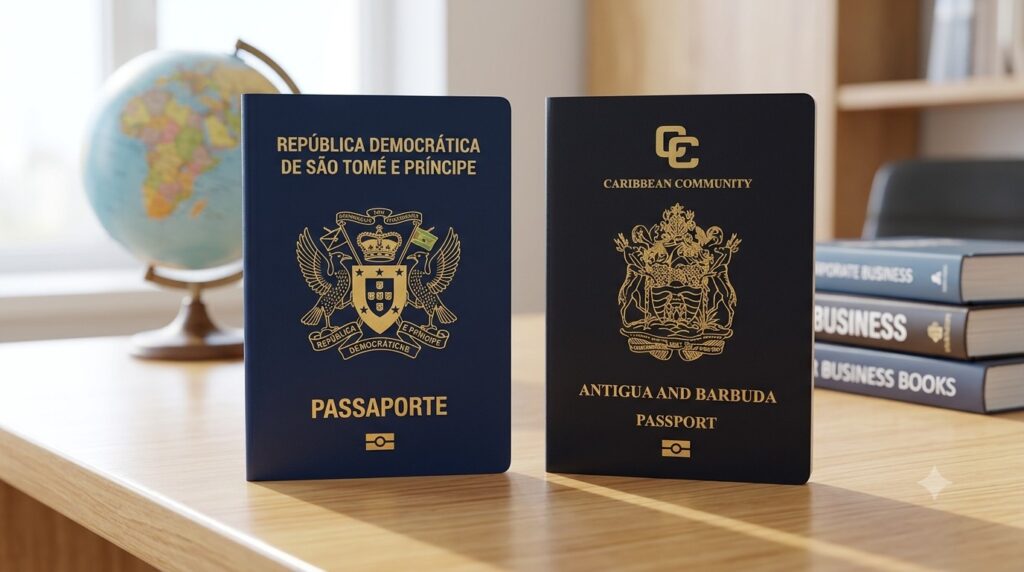
Every few years a new citizenship by investment program launches at a price that undercuts the established market, and the industry splits into two camps: the agents who market it aggressively, and the advisors who quietly tell clients to wait.
São Tomé and Príncipe is the current test case. At $90,000 it is less than half the Caribbean’s regulated minimum, it processes in weeks rather than months, and it comes with a structural feature none of the Caribbean programs can offer.
It also has roughly six months of operating history.
The honest answer to Sao Tome vs Caribbean citizenship — the comparison now dominating enquiries at the lower end of the market — is that the two are not competing for the same client. Understanding why requires being specific about what each one actually sells.
What São Tomé Actually Launched
The program rests on Decree-Law No. 07/2025, approved in May 2025 and effective 1 August 2025 following publication in the Official Gazette, with underlying statutory authority from Nationality Law No. 07/2022. This matters: the program is grounded in published primary legislation, not a ministerial discretion arrangement of the kind that has collapsed elsewhere.
The mechanics:
- $90,000 non-refundable contribution to the National Transformation Fund, reported to cover a main applicant and up to three dependents, plus a $5,000 submission fee and approximately $5,000 per additional family member.
- No residency, visit, language, or cultural knowledge requirement. Dual citizenship permitted. Fully remote.
- Processing averaging around 2.5 months, with some approvals reported inside one month.
- First citizenship certificates and passports issued in January 2026, following an initial cohort of 27 approvals.
That last figure is the one to hold in mind throughout this comparison. Twenty-seven approvals is a pilot, not a track record.
The Caribbean Benchmark
The five Eastern Caribbean programs are what São Tomé is measured against, and the comparison has changed since 2024.
Since 1 July 2024, all five have been bound to a US$200,000 minimum contribution under an OECS Memorandum of Agreement, which ended the regional price war. Dominica sits at the $200,000 entry point; St Kitts and Nevis is highest at $250,000. Processing typically runs four to eight months, with no relocation required.
What that price now buys is a different product than it did five years ago. Under sustained diplomatic pressure from the EU, UK and US, the region has shifted from competing on cost to competing on compliance — coordinated due diligence standards, mandatory interviews, and shared applicant screening. Slower and more expensive is the intended outcome, not a failure of the reform.
St Kitts and Nevis has operated its program since 1984. That is four decades of visa-policy relationships, banking recognition, and precedent.
Where São Tomé Genuinely Wins
Price, particularly for larger families
At $90,000 plus fees against a $200,000 Caribbean floor, São Tomé is not marginally cheaper — it is roughly 55% below the entry point of the cheapest regulated Caribbean option. For a family of four, the gap widens further under the reported fee structure.
For clients whose objective is a second nationality held in reserve rather than an active travel document, this is the difference between a decision and a non-decision.
Speed
Two to three months against four to eight is material for anyone operating under a real deadline — a pending regulatory change, a business transaction requiring a non-primary nationality, or renunciation planning with a fixed timeline.
The CPLP advantage
This is the feature the Caribbean cannot replicate and the one most often underexplained.
São Tomé and Príncipe is a member of the Community of Portuguese Language Countries (CPLP). That membership gives its citizens access to simplified residency pathways in Portugal and Brazil — reduced documentation, streamlined entry, and in Portugal’s case a shorter naturalisation timeline for CPLP nationals than the ten years now applied to most other non-EU nationals under the nationality law promulgated on 3 May 2026.
The strategic implication: São Tomé citizenship is not only a passport. For the right client it is an entry point into a European residency track at a fraction of Golden Visa cost. Anyone marketing it as an automatic route to Portuguese citizenship is overstating it — the CPLP route still requires actual residency in Portugal, which most CBI clients have no intention of establishing. But as a structural option held in reserve, it is real, and no Caribbean passport carries an equivalent.
Where the Caribbean Wins Decisively
The mobility gap is not close
The São Tomé passport provides visa-free or visa-on-arrival access to roughly 60 to 70 destinations, depending on the index used. Caribbean passports range from approximately 140 to 167.
More important than the count is the composition. Every Caribbean CBI passport carries Schengen Area access. São Tomé does not. Antigua and Barbuda, Grenada, and St Kitts and Nevis additionally hold UK visa-free entry as Commonwealth members, with stays of up to 180 days via electronic travel authorisation; Dominica and St Lucia require standard visitor visas.
If the client’s objective involves travelling to Europe on the second passport, this comparison ends here. São Tomé does not solve that problem at any price.
Institutional track record
Four decades of Caribbean operation has produced something that cannot be bought quickly: banks that recognise the passport for account opening, insurers that price it, immigration officers who have seen it before, and — critically — a documented history of how the issuing government behaves when a program comes under international pressure.
Who Each Program Actually Suits
São Tomé is the better fit if: the budget is genuinely constrained, the family is large, speed matters more than travel access, the objective is a reserve nationality rather than an active document, or the CPLP-to-Portugal pathway is part of a longer plan.
The Caribbean is the better fit if: the passport will be used for travel — particularly to Europe or the UK, the client needs institutional recognition for banking or business, the family will rely on it for a decade or more, or the client’s risk tolerance does not accommodate a program with six months of history.
A note on taxation, since it is the most common misconception in both directions: neither citizenship changes your tax residence by itself. Neither São Tomé nor any Caribbean nation taxes non-resident citizens on worldwide income, but nor does acquiring either passport alter your obligations to your current jurisdiction. US citizens in particular remain subject to worldwide taxation regardless of how many nationalities they hold.
The Verdict
São Tomé is a serious program in the sense that matters most — it has a published legal basis, a functioning process, and real passports in circulation. It is not a substitute for a Caribbean citizenship, because it is not selling the same thing.
The right framing is not which program is better. It is whether you are buying mobility or optionality. The Caribbean sells mobility at $200,000 with four decades of proof. São Tomé sells optionality at $90,000 with six months of it. Clients who understand which one they are purchasing rarely regret either decision.
For clients who can wait, the most sensible position is to watch São Tomé through the next four to six quarters. Approval volumes, the parliamentary oversight debate, and any movement on additional visa-waiver agreements will tell you considerably more than any current marketing material.
Frequently Asked Questions
Is São Tomé citizenship by investment legitimate? Yes. It is established under Decree-Law No. 07/2025, effective 1 August 2025 and published in the Official Gazette, with statutory authority from Nationality Law No. 07/2022. The first passports were issued in January 2026.
How much cheaper is São Tomé than Caribbean citizenship? The São Tomé contribution starts at $90,000 plus fees, against a regulated $200,000 minimum across all five Eastern Caribbean programs — roughly 55% below the cheapest Caribbean option.
Does a São Tomé passport give Schengen access? No. It provides visa-free or visa-on-arrival access to approximately 60 to 70 destinations and does not include the Schengen Area. All five Caribbean CBI passports do.
What is the CPLP advantage of São Tomé citizenship? As a CPLP member state, São Tomé citizens can access simplified residency pathways in Portugal and Brazil, with a shorter naturalisation timeline in Portugal than most non-EU nationals face. The pathway still requires establishing actual residency.
How long does São Tomé citizenship take compared to the Caribbean? São Tomé processing averages around 2.5 months, with some approvals inside one month. Caribbean programs typically run four to eight months.
Sao Tome vs Caribbean citizenship — which should I choose? If the passport is for travel, particularly to Europe or the UK, choose the Caribbean. If the objective is a low-cost reserve nationality, a large family, speed, or a CPLP pathway into Portugal, São Tomé is the stronger value.
Speak With Our Advisors
Our teams in Dubai and New York advise families across the Caribbean, Africa, Europe and Latin America — including direct engagement with newly launched programs where independent verification matters most. We will tell you when a program is not the right fit.