

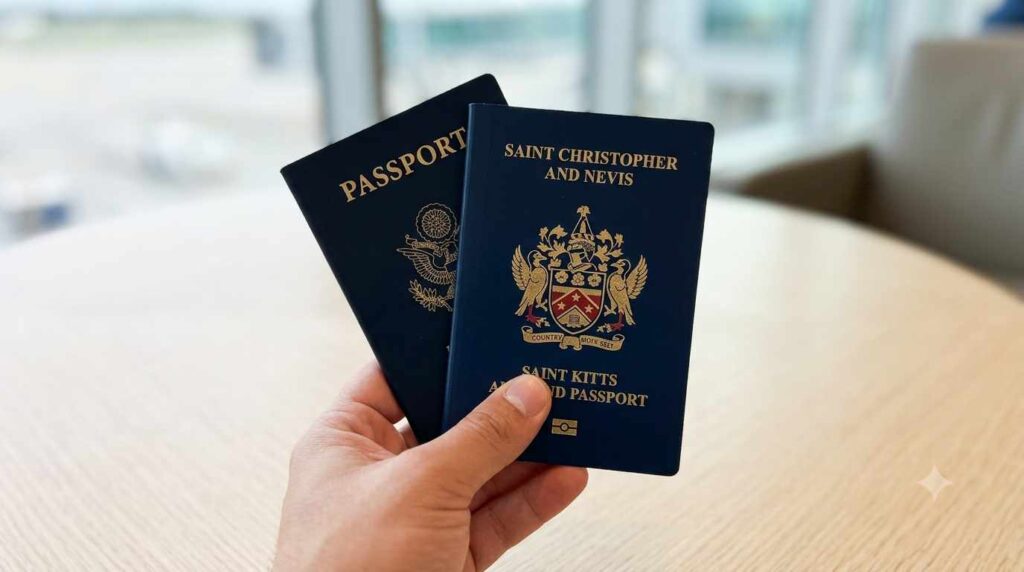
Americans Are Applying for Second Passports in Record Numbers — Here’s Where They’re Going in 2026
For most of the modern history of investment migration, Americans were an afterthought. The industry was built for investors whose passports limited where they could travel, bank, or educate their children — problems a US passport solved on its own.
That assumption no longer holds. Demand for a second passport for Americans has become the single largest driver of the global citizenship and residency by investment market, and unlike previous cycles, this one is not about travel.
The Numbers
Applications from US nationals for residence and citizenship abroad doubled in 2025 versus 2024 and remained elevated through the first half of 2026, according to trusted reports. Investor citizenship filings by Americans rose more than 75% in 2025, following a spike of over 400% in 2020. US nationals have been the largest single source of applications since 2023, at roughly 23% of all applications — close to the combined total of the next four nationalities.
The decisive figure is a different one: approximately 93% of US applicants still live in the United States. This is not a story about Americans who have already left. It is a story about wealthy Americans buying an option — and, increasingly, about the smaller group who go on to exercise it.
Political Instability Has Replaced Convenience as the Driver
Professor Peter J. Spiro of Temple University Law School characterises the current wave as Americans catching up to their Latin American counterparts, who have long recognised the value of an exit option after living through cycles of instability. What is new, in his assessment, is that many Americans are anxious for the first time about fundamental shifts in the country’s institutional character — not merely about who wins the next election.
The 2026 midterm cycle has kept that concern active rather than resolving it. A Harris Poll found that almost half of all Americans — and two-thirds of Gen Z and Millennial respondents — would like to hold dual citizenship, with roughly a quarter citing “greater security and stability” as a motivation.
There is also a specific policy risk clients now ask about directly. Senator Bernie Moreno introduced the Exclusive Citizenship Act of 2025, which would require Americans to relinquish additional nationalities within a year or forfeit US citizenship. Legal consensus is that it will not advance, and that it would likely fail constitutional review under Vance v. Terrazas (1980), which held that citizenship can only be lost through acts undertaken with specific intent to relinquish it. A YouGov poll taken after the proposal found only 21% of Americans consider dual citizenship harmful to the country.
The practical effect of the bill has been the opposite of its intent: it accelerated applications among Americans who read it as evidence that the option may not remain open indefinitely.
Tax Restructuring: What Offshore Jurisdictions Can and Cannot Do
This is where the most expensive misunderstandings occur, and where advisory quality separates most sharply.
The rule that governs everything else
A second passport does not change your US tax position. The United States taxes citizens on worldwide income regardless of where they live or how many other nationalities they hold. Acquiring citizenship in Dominica, Nauru, or Portugal has no effect on your Form 1040, your FBAR obligations, or your FATCA exposure. Under CRS and FATCA information exchange, foreign accounts are visible to the IRS as a matter of routine.
What offshore restructuring does change is the tax treatment applied by the second jurisdiction, and the range of options available to a family whose assets and residency rights sit in more than one legal system.
Territorial and zero-tax jurisdictions
Panama taxes only Panama-source income; the UAE levies no personal income tax. These are genuine advantages for the non-US members of a family structure, for holding companies, and for Americans planning years ahead toward a change in tax status — but they are not a way for a US citizen to stop filing.
The Foreign Earned Income Exclusion and foreign tax credits reduce double taxation for Americans abroad, but the exclusion is capped and covers earned income only — not capital gains, dividends, or carried interest, where most HNWI income sits.
Americans Are Renouncing in Record Numbers
Renunciation used to be a rounding error. Before 2009, roughly 200 to 400 Americans renounced in a typical year.
Close to 5,000 renounced in 2025, the highest figure since the all-time record of 6,705 in 2020. Analysts estimate that global demand for renunciation appointments now exceeds 30,000 — a backlog constrained by consular capacity rather than by demand.
The trajectory is likely to steepen. In a final rule published on 13 March 2026 and effective 13 April 2026, the State Department cut the fee for a Certificate of Loss of Nationality from $2,350 to $450 — an 80% reduction that removes the last meaningful administrative barrier.
Where the Money Is Going
Europe — Greece has displaced Portugal
Greece is now the leading European destination for American applicants, with thresholds tiered by location: €800,000 in Athens, Thessaloniki, Mykonos and Santorini; €400,000 elsewhere; €250,000 for qualifying restoration projects. No minimum stay is required — decisive for applicants intending to remain US-resident.
In Portugal, a revised Nationality Law promulgated on 3 May 2026 extended general naturalisation from five years to ten for most non-EU and non-CPLP nationals. Against Greece’s seven-year path to an EU passport, that gap explains most of the traffic shift. Malta’s citizenship route closed entirely after the CJEU ruled it unlawful on 29 April 2025; it still offers a path to citizenship based on exceptions, and its Permanent Residence Programme survives as residency only.
The Caribbean — the standard direct-citizenship route
Since 1 July 2024, all five Eastern Caribbean programs have been bound to a US$200,000 minimum under an OECS agreement, ending the region’s price war. Dominica sits at the entry point, St Kitts and Nevis highest at $250,000, with processing typically four to eight months and no relocation.
One note specific to US readers: Grenada’s E-2 treaty with the United States is its principal premium feature — and it is worthless to someone who already holds US citizenship. Americans should not pay for it.
Low-cost entrants and Latin America
Nauru offers contributions at $90,000 until 31 December 2026, reverting to $115,000 thereafter. São Tomé and Príncipe has issued citizenship from $90,000 since September 2025, fully remote in roughly two months. Both function as low-cost insurance — a nationality held in reserve, frequently by clients whose real horizon involves eventual renunciation.
Panama remains the most-used Western Hemisphere option on the strength of its territorial system, with the Qualified Investor Visa granting permanent residency from day one at $300,000.
Frequently Asked Questions
Will a second passport reduce my US taxes?
No. The US taxes citizens on worldwide income regardless of additional nationalities. Only formal renunciation changes that, and it triggers the exit tax regime under IRC §877A.
How much does a second passport for Americans cost in 2026?
Direct citizenship starts near $90,000 in Nauru and São Tomé and Príncipe, and $200,000 in the Caribbean under the OECS floor. European residency routes leading to citizenship start at €250,000 in Greece.
How many Americans are renouncing US citizenship?
Close to 5,000 in 2025, against 200–400 per year before 2009. The State Department cut the renunciation fee from $2,350 to $450 effective 13 April 2026, and appointment demand is estimated above 30,000 globally.
Do I need a second citizenship before renouncing?
Yes. No country may render a person stateless, so another nationality must be secured first — typically two to five years in advance.
Can Americans legally hold dual citizenship?
Yes. The Exclusive Citizenship Act of 2025 proposed ending this but is not expected to advance.
Speak With Our Advisors
Our teams in Dubai and New York advise American families on citizenship and residency by investment across the Caribbean, Europe, the Pacific, and Latin America — working alongside your existing counsel to structure applications around political risk, succession, and long-term tax positioning.